One question comes up more than any other.
“Should I start small and scale up? Or should I go all-in right now?”
I hear this every single week. And honestly? Both options feel risky.
Spend too little, and you’re just burning cash with nothing to show for it. Spend too much too fast, and you might drain your reserves before the leads start flowing.
Here’s what nobody wants to admit.
Playing it “safe” has a cost, too. Every month you underinvest, your competitor is scooping up the customers that should be yours.
At Elevated HVAC Marketing, we’ve helped contractors at every stage figure out the right investment level. Today, we’re going to do the math together.
No fluff, no vague promises. Just the numbers.
The LSA-Only Trap
Google Local Services Ads are incredible. I love them.
You pay per lead, not per click. And you can dispute garbage leads and get your money back.
For a contractor with a tight budget, LSA feels like a safe bet. I get it.
But here’s the problem: LSA has a ceiling. There’s only so much inventory in your market. Once you max out your budget or hit the lead cap, that’s it. You can’t buy more visibility.
And what happens when a competitor with deeper pockets outspends you? Or when Google raises the cost per lead by 20% overnight?
You’re stuck.
Relying solely on LSA is like only eating protein bars—they’re great in a pinch, but terrible as a lifestyle.
It’s a single point of failure. And in business, single points of failure will eventually fail.
The Multi-Channel Advantage
The top-performing HVAC companies understand that marketing isn’t about finding the one magic channel. It’s about building a system where multiple channels work together.
- LSA catches the emergency repair customer Googling frantically.
- PPC targets the homeowner researching “ductless mini-split installation” before summer.
- Search Engine Optimization (SEO) brings in organic traffic that costs you nothing per click.
- Retargeting follows up with the 97% of visitors who didn’t book on their first visit.
- Email marketing reactivates your existing customer base for tune-ups and memberships.
When you stack these channels, something powerful happens.
The homeowner sees your LSA ad. Then they visit your website. Then they see your retargeting ad on Facebook. Then they get an email reminder.
By the time they’re ready to buy, you’re the only name they remember.
It’s the “surround sound” effect. One fishing line catches one fish. A net catches dinner for the whole crew.
6-Month Projection: Kickstart vs. Grow
Let’s get specific.
At Elevated HVAC Marketing, we offer different pricing packages based on where you are in your business. Two of the most common starting points are Kickstart and Grow.
Kickstart is built for contractors under $1M in annual revenue who need a steady lead system.
You get Google LSAs (setup, management, and dispute handling). You get a custom website with call tracking and reputation management. You get core SEO with 2 pages per month and monthly strategy calls.
It’s lean, focused, and builds the foundation.
But there’s no PPC, email marketing, automation, or social media.
Grow is built for contractors doing $1M–$5M who are ready for consistent inbound leads and real growth.
You get everything in Kickstart, plus Google Ads PPC. You get enhanced SEO with four pages per month and backlink building. You get bi-weekly strategy calls, email marketing, basic automation, and social media management.
It’s a machine, not just a channel.
Here’s what the 6-month projection typically looks like:
The gap isn’t just incremental. It’s exponential.
Grow doesn’t just add more leads. It compounds them.
When Kickstart Makes Sense
I’m not here to tell you that bigger is always better.
Sometimes Kickstart is exactly the right call.
If you’re under $1M in revenue and still building your operational foundation, flooding your board with leads can actually hurt you. You’ll burn through customers with long wait times and sloppy service.
If your tech capacity is maxed out, more leads just means more “sorry, we’re booked” phone calls. That’s a reputation killer.
If cash flow is genuinely tight, it’s smarter to build a sustainable base than to swing for the fences and miss.
Kickstart lets you crawl before you sprint.
There’s no shame in that. It’s strategic patience.
The key is knowing when you’ve outgrown it.
When Grow Pays Off Faster
Here’s when Grow becomes the obvious choice.
You’ve got trucks sitting idle because the phone isn’t ringing enough. You have capacity, but not enough leads to fill it.
You’re stuck at a revenue plateau. You’ve been hovering around the same number for two years and can’t seem to break through.
Your competitors are showing up above you in search results. They’re outbidding you on Google. They’re stealing your customers in your own zip code.
Shoulder season is crushing you. Spring and fall feel like a ghost town because you have no way to generate demand when the weather isn’t doing it for you.
Grow solves these problems because it doesn’t just capture existing demand. It creates new demand through email, automation, and PPC targeting.
Here’s the uncomfortable truth.
Your competition isn’t waiting for you to “feel ready.”
Every month you delay, they’re grabbing market share you’ll have to fight twice as hard to win back.
Break-Even Timeline for Each Approach
So, when do you get your money back?
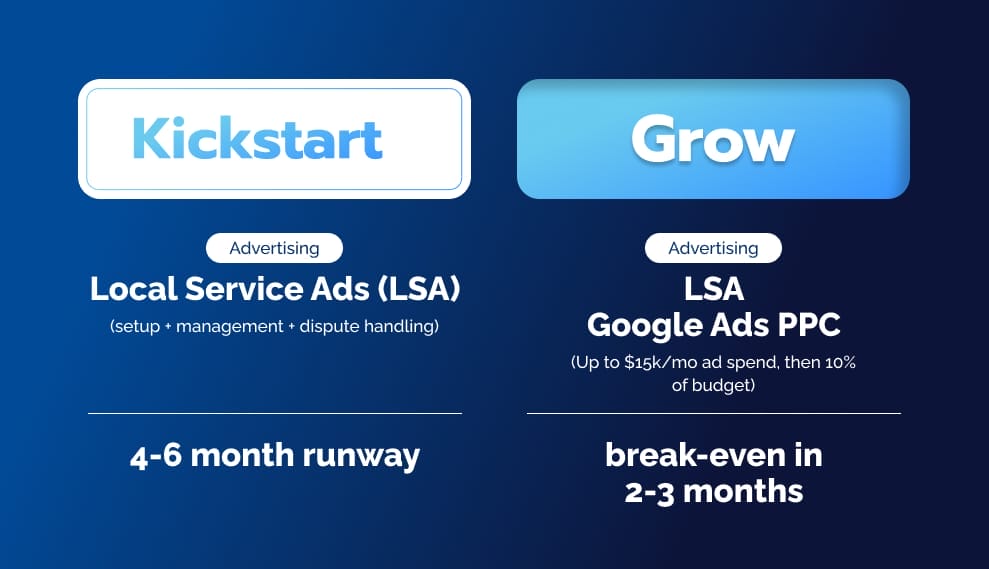
With Kickstart, expect a 4-6 month runway before you see meaningful ROI.
LSA needs time to ramp up. Google has to verify your business, your reviews need to be built, and the algorithm needs data. SEO is also a long game. The foundation you’re building now pays off in months 6, 9, and 12.
It’s a slow drip. Steady, but slow.
With Grow, most clients hit break-even in 2-3 months.
Why?
Because PPC delivers immediately. While your SEO is building, your paid ads are filling the gap. Email marketing reactivates past customers who are ready to buy now.
Then the compounding kicks in.
By month 4, your organic rankings start climbing. By month 6, you’ve got a flywheel. Paid, organic, email, and retargeting are all feeding each other.
It’s not a slow drip now. It’s an avalanche.
The Real Cost of Waiting
Every month you wait to invest properly is revenue you will never recover.
That homeowner who needed a new system last Tuesday? They already called your competitor. They’re gone.
The shoulder season you just survived on fumes? That was preventable with the right email campaigns and tune-up promotions.
The technician you had to let go because there wasn’t enough work? That was a marketing problem, not a demand problem.
Waiting until you “feel ready” is the most expensive decision you can make.
The best time to build your marketing machine was last year. The second best time is today.
So, Which Investment Level is Right for You?
Both Kickstart and Grow have their place.
If you’re early-stage, capacity-constrained, or cash-tight, Kickstart builds the foundation you need without overextending.
If you’re ready to break through a plateau, fill empty trucks, and dominate your local market, Grow gets you there faster.
The question isn’t “Can I afford to invest?”
It’s “Can I afford not to?”
The math doesn’t lie. And your competitors aren’t waiting.
Ready to see what the next 12 months could look like for your business?
Let’s do the math together.