Build a documented system that delivers predictable leads through a high-performance HVAC marketing plan. You will produce a 1-year strategy managed through weekly execution and monthly review loops. This guide is for owners and managers who need consistent volume during peak and shoulder seasons without the feast-or-famine cycle. Expect to spend two hours drafting your initial system.
Before starting, gather your last 12 months of revenue by service, average ticket, booking rates, current marketing spend, and service area ZIPs. You also need access to your website, ad accounts, and Google Business Profile. This strategy coordinates digital, offline, and retention marketing channels to dominate your territory. We use this framework to generate over $80M in annual revenue for our partners.
Start by choosing exactly what “winning” means for your business this year.

Define Your Growth Targets and Service Mix
Generic revenue goals lead to wasted spend. If growth comes from low-margin repairs that redline your techs in July, you aren’t scaling; you’re burning out your crew for crumbs. You need marketing-aligned goals that prioritize the right calls at the right margins.
Write 2–3 measurable 12-month goals based on HVAC reality:
- Target replacement installs/month (e.g., 15 units).
- Service calls/month during shoulder seasons (April and October).
- Maintenance agreements added monthly to build recurring revenue.
Define your service mix priorities. Decide if you want more emergency repairs, maintenance, replacements, or IAQ accessories. Your marketing should follow your highest profit margins, not just your current availability.
Perform a capacity check as a reality gate. Audit your number of trucks, dispatcher coverage, and install crew capacity. If you have three techs but set a goal for 100 installs, your plan will fail at the dispatch desk. Identify bottlenecks, such as limited install leads, before spending a dollar on ads.
Choose one primary KPI as your win condition. Determine if the plan is a success based on booked appointments, sold installs, or recurring memberships.
Create a one-page Targets Sheet listing these goals, constraints, and your KPI. This document ensures your marketing spend stays tied to actual shop capacity.
Map Your Service Territory and Customer Lanes
Separate your B2C and B2B funnels to ensure your messaging and follow-up protocols do not conflict. Generalist agencies often treat every lead the same, but a high-performance HVAC marketing plan requires distinct lanes for residential and commercial targets.
- Split your audience lanes:
- Residential Homeowners: Focus on urgent repairs and replacement research. These leads are high-emotion and crisis-driven.
- Commercial/Property Managers: Target facility directors and restaurants. These leads prioritize reliability, professional billing, and long-term service agreements over quick coupons.
- Define geography like an operator: Identify Primary ZIP Codes where you can serve fast. These areas should yield your highest close rates due to low travel time and high brand density. Categorize Secondary ZIP Codes as overflow territory reserved for high-ticket installations or light schedule gaps.
- Develop two simple personas:
- Residential: Focus on trigger events like system breakdowns or remodels. Address objections regarding price and trust by providing proof through Google Business Profile reviews and Google Guaranteed badges.
- Commercial: Focus on tenant complaints or compliance inspections. Address availability objections by providing case studies, industry certifications, and guaranteed response times.
- Set lead-handling protocols: Residential leads require automated after-hours capture to win the “speed to lead” race. Commercial leads require a professional, next-business-day follow-up with a formal proposal.
Document these lanes and boundaries into a one-page Audience + Area Map. Use this map as the primary filter for every channel selection, ad targeting setting, and staffing decision you make.
Analyze Your Local Market and Internal Baseline
Stop guessing why the phone isn’t ringing. A 60-minute internal audit turns “marketing feelings” into a data-driven baseline. This process identifies the holes in your bucket before you pour money into an HVAC marketing plan.
Perform an internal audit using this scorecard:
- Website: Verify mobile load speed is under 3 seconds. Ensure “Book Now” buttons are visible without scrolling. Service pages must clearly highlight financing options and maintenance plan visibility.
- Google Business Profile (GBP): Check review velocity. If you haven’t received a new review in 48 hours, your local ranking will eventually tank.
- Paid Ads: Confirm LSAs and PPC are active. Verify you are disputing junk leads for credits and that call tracking records every intake.
- Reputation: Ensure automated SMS review requests trigger the moment a tech closes a job in ServiceTitan or Housecall Pro.
- Offline: Evaluate truck wraps for legibility at 45 mph, yard sign frequency, and active HOA or local partner relationships.
Conduct a competitor sweep of 3 to 5 local rivals: Document their financing offers, same-day service promises, and review ratings. Note exactly where they appear in Maps and LSAs. If a competitor has 500 more reviews than you, they are training your customers to expect that level of social proof.
Identify your table stakes (must-haves to compete) versus your differentiators (unique claims you can prove). Use these insights to refine your HVAC marketing strategies for the shoulder season.
Output: Create a “Fix First” list of the top 5 issues that would waste ad spend if ignored. Resolve these gaps before scaling your budget.
Craft Your Core Message and Offer Stack
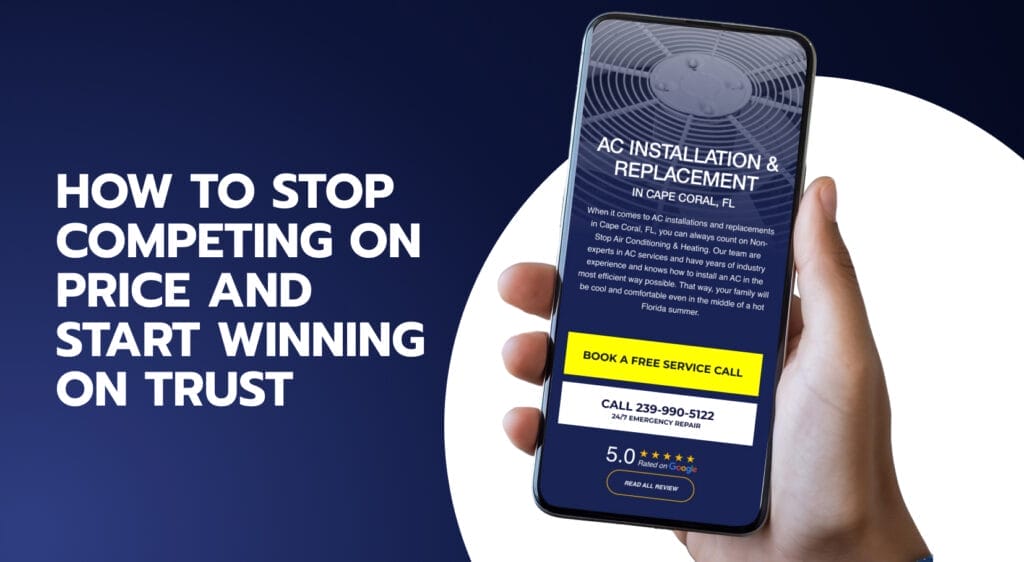
A generic “free estimate” is no longer a differentiator; it is a lead-quality killer. A successful HVAC marketing plan requires a Messaging Sheet that positions you as the only safe choice in your territory so you don’t have to compete on price alone.
1. Draft Your Value Proposition
Define your position using three concrete parts:
- Who you serve: Identify your specific service area and segment (e.g., “Residential homeowners in Bucks County”).
- What you do: Focus on high-value services like 24/7 emergency repair or high-efficiency installs.
- Why you’re the safe choice: Use specific metrics. Replace “quality service” with 2-hour arrival windows, 10-year parts and labor guarantees, or NATE-certified expertise.
2. Build Your Seasonal Offer Stack
Avoid static discounts. Map your offers to seasonal demand:
- Pre-season: Precision tune-ups to fill the shoulder season.
- Peak season: Same-day emergency repair promises.
- High-ticket: Replacement consults paired with 0% financing.
- Retention: Maintenance club memberships that offer priority dispatching.
3. Verify Your Proof Points
Every marketing asset must pass a trust audit. Ensure these five elements are present:
- Recent Google reviews and testimonials.
- Industry badges (Google Guaranteed, BBB, NATE).
- Real before and after photos of clean installs.
- Specific, written performance guarantees.
- Case studies of residential problems solved.
4. Brand Consistency Pass
Verify that your trucks, uniforms, and social media match your website’s visual authority. If your digital brand looks premium but your field presence looks like a “guy in a truck” operation, you break the trust loop.
Output: A Messaging Sheet with one headline, three bullets, and a CTA. For help refining your positioning, book a strategy call to align your message with local market demand.
Solidify Your Digital Foundation and Tracking
Running ads to a broken website is like pouring gas into a leaky tank. Before scaling your HVAC marketing plan, you must fix the infrastructure holes that kill conversions. If your site fails on mobile or your tracking is broken, every ad dollar is a donation to Google. Fix the foundation first to ensure every channel performs.
Ensure every page has one primary CTA, either “Call” or “Book,” as a sticky button visible on mobile. Build dedicated service pages for your priority offerings that include local cues like neighborhood names and zip codes. For paid ads, use a clonable landing page template following this anatomy: benefit-driven headline, social proof, seasonal offer, and a direct lead form.
Optimize your Google Business Profile (GBP) to capture high-intent local demand. Verify your primary category is accurately set to HVAC Contractor and commit to a weekly photo cadence showing real jobs and branded vans. Implement a review request process to ensure your rating stays above 4.7 stars to dominate the map pack.
Install a tracking setup to measure how SEO, LSA, and PPC interact to drive actual revenue. Implement call and form tracking, then define conversions as booked appointments rather than just website visits. If you suspect your setup is leaking leads, get a free SEO audit to identify cracks before increasing your spend.
Foundation Checklist:
- Website: One primary CTA visible and clickable on mobile? (Pass/Fail)
- GBP: Weekly photo cadence and review automation active? (Pass/Fail)
- Tracking: Call and form tracking firing with revenue attribution? (Pass/Fail)
Build Your Channel Stack for Balanced Growth
Stop trying to be everywhere at once. The most common mistake in an HVAC marketing plan is spending money without giving every dollar a specific job. If you chase every shiny object, you will end up with high lead costs and an empty schedule by Tuesday. Success requires selecting the right marketing channels based on your capacity, service mix, and timeline.
Use this decision framework to select your channels:
- Demand Capture (Leads this week): Prioritize Google LSAs and PPC. These fill your board immediately but cost the most per lead.
- Asset Building (Cheaper leads over time): Invest in SEO and local service pages. This builds equity and reduces dependency on expensive rent-style ads.
- Retention (Smooth shoulder seasons): Market maintenance plans and run database reactivation to keep trucks moving when weather is mild.
Organize your selection into three strategic tiers:
- Tier 1 (Non-negotiables): Google Business Profile, automated review generation, and a conversion-optimized website.
- Tier 2 (Growth Levers): LSAs, Google PPC, and SEO city pages.
- Tier 3 (Scale Layers): Meta retargeting, YouTube shorts, and offline tactics like “five-around” door hangers or yard signs around active jobs. Include community sponsorships and realtor relationships to build local authority.
Finalize your Channel Stack by defining the primary job and CTA for each:
- LSAs/PPC: Emergency repairs. Primary CTA: Call now.
- SEO: Replacement installs. Primary CTA: Book estimate.
- Direct Mail/Signs: Neighborhood branding. Primary CTA: Visit website.
- Email/SMS: Maintenance and memberships. Primary CTA: Schedule tune-up.
Select your stack and hold these channels accountable for at least 90 days before making adjustments. Your goal is a balanced mix of online and offline demand.

Develop Your 12-Month Seasonal Marketing Calendar
Planning in 12-month blocks eliminates “panic planning” when shoulder seasons hit. Instead of wondering why the phone is quiet in October, you should already be executing a furnace safety campaign built in August. This calendar transforms seasonality from a crisis into a predictable, executable schedule.
Create a grid running three campaign types simultaneously:
- Acquisition: LSA, PPC, and SEO to capture new demand.
- Retention: Email and SMS to reactivate past customers.
- Reputation: Automated review requests to boost Map Pack rankings.
Map your seasonal focus by region. Target pre-season tune-ups in the spring, shift to peak breakdown service in summer, focus on maintenance in fall, and push Indoor Air Quality (IAQ) or emergency heat in winter.
Follow the database mining first rule: Before increasing paid ad spend for any seasonal campaign, run a reactivation blast to your existing customer base. It is always cheaper to book a tune-up with a past client than to buy a new lead on Google.
Set production deadlines for landing pages and ad creatives 30 days before launch. This ensures your HVAC marketing strategies are active the moment the weather shifts. Your final calendar must define:
- Offer: (e.g., $79 Precision Tune-up)
- Audience: (e.g., Past customers within a 10-mile radius)
- Channel: (Email, LSA, Facebook)
- Dates: Launch date and 30-day prep deadline
- Success Metric: Target cost per lead (CPL) or total booked jobs
Calculate Your Defensible Budget and Allocation
Professional contractors do not treat marketing as an expense. They treat it as the purchase price of a customer. To scale without gambling your cash flow, you must calculate exactly what it costs to “buy” a new job before enabling a campaign.
Back into your required volume based on the revenue goal from Step 1. If you want $1,000,000 in new replacement revenue and your average ticket is $10,000, you need 100 installs. Plug in your specific conversion assumptions to define your lead target:
- Booking-to-sale close rate: If you close 50%, you need 200 appointments.
- Lead-to-booking rate: If you book 70%, you need 286 leads.
Translate these 286 leads into budget ranges based on your local market. In competitive territories, Google LSA or PPC leads range from $80 to $250. Review this Google Ads checklist to ensure your accounts are not leaking cash. You must track your true cost per booked job in your CRM to verify these numbers against your ad dashboard.
Allocate your total budget across these four categories to balance immediate demand with long-term growth:
- Demand Capture (50–60%): Immediate leads from LSAs and PPC.
- Asset Building (20–30%): Long-term SEO and website optimization.
- Retention (10%): Email, SMS, and membership marketing.
- Offline/Community (10%): Truck wraps, local events, and yard signs.
Finalize this step with a one-page Budget + Targets sheet. Include monthly spend caps and a reallocation rule: every 30 days, shift 10–20% of the budget to the channel with the lowest cost per booked job. This ensures your capital follows performance as seasonality shifts your capacity.

Operationalize Your Tracking and Monthly Review Process
Stop treating marketing reports like a utility bill. To build an effective HVAC marketing plan, connect ad spend directly to revenue in your CRM. If your agency cannot show which keyword led to a specific paid invoice, your tracking is broken.
The Minimum Scoreboard
Define your dashboard with these five essential metrics:
- Leads by channel: Track calls and forms individually to see what drives volume.
- Cost per lead (CPL): Know your exact cost for every inquiry.
- Booking rate: The percentage of leads that become appointments.
- Close rate: The percentage of appointments that become sales.
- Cost per booked job + CPS: Your true customer acquisition cost.
Follow-Up SOPs
Operationalize intake with strict follow-up protocols. Set a speed-to-lead target of under two minutes for form fills. Use AI chatbots or an answering service to capture after-hours intent. Every unreturned call is a lead handed to your competitor, so implement automated text-backs for missed calls within 60 seconds.
The Monthly Review Process
Establish a 60-minute monthly optimization meeting to force decisions. Review what you spent, what booked, and what actually sold. Identify three specific fixes for next month, such as refreshing ad creative, improving landing page speed, or narrowing geo-targeting to high-margin ZIP codes.
This repeatable rhythm ensures your spend translates into real profit. If you need an expert to validate your tracking or build your scoreboard, book a strategy call to audit your current plan.
Pro Tips for High-Performance HVAC Marketing
Automate the speed-to-lead race. Use AI-driven chat and booking prompts to capture website visitors 24/7. Integrate these tools with your CRM like ServiceTitan or Housecall Pro to reduce booking friction and measure every interaction. Homeowners book with the first company that responds during a crisis. If you rely on office staff for after-hours leads, you will lose 40 percent of your volume to automated competitors.
Implement a “real shop” creative system. Stop relying on stock photos for Meta ads. Film 5 to 10 clips every month featuring technician tips and before-and-after installs. Authentic footage builds trust faster than high-end production. If you fail to rotate fresh creative frequently, your ad performance will plateau as homeowners develop “banner blindness” to your static offers.
Prioritize database reactivation before increasing ad spend. Running pre-season reactivation campaigns to past customers is the highest-ROI move for your HVAC marketing plan. Use SMS and email to push tune-ups to your list. It costs five times more to acquire a new customer than to retain an existing one. Skipping this step results in wasted budget on high-cost acquisition.
Build a permanent recruitment marketing lane. Growth stalls when lead generation outpaces your technician count. Treat your Careers page with the same conversion focus as your service pages. Run always-on hiring ads featuring your actual team culture. Without this lane, you may be forced to turn off profitable ad campaigns because you lack the manpower to fulfill demand.
Avoid the single-channel trap with integrated tracking. Relying on one channel like Google LSAs leaves you vulnerable to algorithm changes that kill lead flow overnight. A professional strategy uses an integrated approach where paid and organic visibility complement each other. See how SEO, LSA, and PPC interact. Tracking booked jobs ensures your budget supports high-ticket replacements instead of low-margin service calls.
Frequently Asked Questions About HVAC Marketing Plans
What should an HVAC marketing plan include?
An effective HVAC marketing plan must go beyond a simple list of ads. It should define your specific growth goals, service mix priorities, and target audience lanes. You need a coordinated channel stack of online and offline tactics, a 12-month seasonal calendar to flatten the shoulder seasons, and a clear budget based on realistic customer acquisition costs. Finally, include a robust tracking system to measure leads from the initial click all the way to booked revenue in your CRM.
Should I focus on SEO or paid ads first?
If you need leads today, start with Google Local Services Ads (LSAs) and PPC to capture immediate demand. However, you should build your SEO foundation simultaneously. While paid ads stop producing the moment you stop paying, SEO builds long-term equity that lowers your average lead cost over time. Most successful contractors run a hybrid strategy to stay busy now while owning their market later. Learn more about how SEO, LSAs, and PPC work together.
How much should I budget for HVAC marketing?
A common benchmark is to reinvest 5 to 10 percent of your revenue into marketing for maintenance, or 10 to 20 percent if you are in aggressive growth mode. However, the best budgets are built using funnel math rather than fixed percentages. Calculate your lead-to-booking and booking-to-sale rates to determine exactly how many leads you need to hit your revenue targets. Your market’s competitive density will ultimately dictate your final spend.
How long does it take to see results?
Paid channels like Google LSAs or PPC can produce leads within days once your accounts are approved and launched. SEO is a long-term investment that typically takes 3 to 6 months to show significant ranking shifts and organic lead volume. A balanced plan uses “now” lanes for immediate cash flow and “later” lanes to build a defensible, low-cost lead source for the future.
How do I market commercial HVAC without wasting money?
Commercial marketing requires a different playbook than residential. Instead of urgent repair offers, focus on B2B pain points like uptime, compliance, and guaranteed response times. Use targeted outreach on LinkedIn or direct mail to reach property managers and facility directors. Build a library of credibility assets, such as case studies and professional maintenance agreement templates, to prove you can handle large-scale operations reliably.
Can I do this myself or should I hire an HVAC marketing agency?
DIY marketing is feasible if you have the time to manage campaigns daily and the discipline to track every dollar spent. However, hiring a specialized HVAC marketing agency makes sense when you need to scale quickly or coordinate multiple channels like SEO, LSAs, and social media. Professional management provides the accountability and technical expertise required to outpace aggressive competitors. If you are ready for expert help, schedule a strategy call with us today.
How does recruitment marketing fit into my plan?
If you generate more leads than your technicians can handle, you are essentially paying to frustrate your customers. Your marketing plan should include an “always-on” hiring lane to ensure you can staff the leads you buy. This includes a high-converting Careers page, social media content highlighting your shop culture, and recruitment ads that run even when you are not currently shorthanded. Scaling your revenue requires scaling your manpower simultaneously.